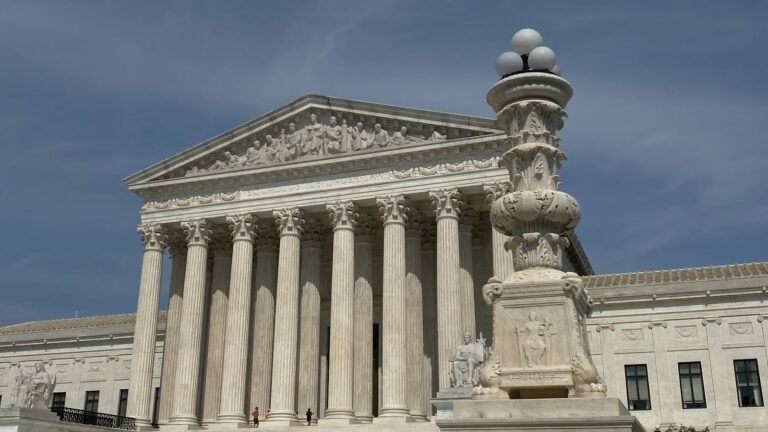
Gov. Jeff Landry suspended U.S. House primary elections just days before early voting, clearing the way for lawmakers to potentially eliminate one of Louisiana’s two majority-Black congressional seats. Critics say the move shatters the long-standing “Purcell principle,” a legal standard that traditionally blocks courts from changing election rules close to voting dates to avoid chaos and voter confusion.
Louisiana used unconstitutional US House maps for past elections. Why not now?
by Piper Hutchinson, Louisiana Illuminator
May 7, 2026
Historically, federal courts have operated under a principle that prevented them from intervening in elections too close to when voters head to the polls so as to not confuse them. In 2022 and 2024, this standard stopped Louisiana from redistricting months ahead of its elections.
This time is different.
The U.S. Supreme Court granted a request Monday from white voters in the redistricting case Louisiana v. Callais to immediately issue an expedited certified opinion, which usually happens about a month after their decision is made public. The white voters believed this would allow Louisiana to adopt new U.S. House district maps for this year’s congressional elections, even though absentee and early voting had already begun in the party primaries for those races.
Two days before early voting, Republican Gov. Jeff Landry issued an executive order suspending the U.S. House primary elections, arguing the court’s ruling required him to do so. It also cleared the way for the GOP-dominated state legislature to redraw Louisiana’s congressional districts, with only one or zero majority-Black seats instead of the current two.
This quick chain of events had been unheard of since the 2006 Supreme Court decision in the case Purcell v. Gonzalez. The precedent became known as the Purcell principle, which has prevented courts from ordering changes too close to an election to avoid voter confusion.
But the court’s expedited certification of the Callais ruling signals a new era, a voting rights expert says.
“I think it’s hard to say the Purcell principle exists,” said Michael Li, senior counsel for the Brennan Center for Justice, a voting rights advocacy organization. “Purcell seems very political now. It seems less like a principle and more like a raw power grab.”
“If you’re a state being ordered to draw a map to expand electoral opportunities for people of color, Purcell will block you from doing that,” Li added. “But if you are a state trying to take opportunities away from people of color, Purcell will not apply.”
Though Louisiana leaders argued a week ago the Callais decision required them to suspend the U.S. House elections, they had acknowledged a day before Landry issued his order that the Purcell principle meant they couldn’t.
“The Purcell principle is a principle that says that courts, particularly federal courts, should not be monkeying with state election dates when it’s too close to an election, but it doesn’t stop the legislature from acting,” Attorney General Liz Murrill said.
When asked about Murrill’s seemingly differing takes, her spokesman Lester Duhé said justices left Louisiana with no other options, as a lower court’s permanent injunction against the state using the 2024 version of the map at issue in the Callais case is back in effect.
“Louisiana’s only option therefore is to draw a new map so that it can hold the election for congressional offices that it is constitutionally required to hold,” Duhé said.
What happened in 2022
That year, then Attorney General Jeff Landry and Solicitor General Liz Murrill argued to the U.S. Supreme Court in June that five and a half months was too close to the November election to change their map. They were defending the U.S. House districts map the legislature had drawn following the 2020 census that maintained just one majority-Black district out of Louisiana’s six seats.
At that time, Louisiana did not have the current closed primary system, so no voting had yet taken place.
“Successful elections demand enormous preparation,” Landry and Murrill wrote in a brief for justices. “Chaotic administration of elections undermines public trust in the election results. Disturbing any step in that process has a cascading effect on many other interlocking and interdependent steps.”
Their plea to the court came as the legislature was refusing to comply with a direct court order from U.S. District Judge Shelly Dick to draw a new congressional map to account for the state’s Black population exceeding 30%. Lawmakers adjourned without approving a second majority-Black district despite the threat of a contempt ruling from Dick, a federal court appointee of President Barack Obama.
Duhé said this year is a different situation than 2022, when Murrill’s and Landry’s brief focused on whether the Purcell principle permitted a federal district court to overhaul processes “on the eve of an election.”
Current Louisiana Senate President Cameron Henry, R-Metairie, was a member of the body in 2022 when lawmakers declined to draw a new map. When asked this week why legislators are moving quickly now as opposed to dragging their feet four years ago, he said they “have the time to do it and the desire to do it [now].”
Former State Rep. Barry Ivey, R-Central, filed legislation in the 2022 session to create a second majority-Black district in Congress for Louisiana. In an interview this week, he said there was no political will at the time to do what the federal court had ordered, which effectively would have removed a Republican seat in the U.S. House.
Ivey said the current situation is different because lawmakers are considering who controls Congress.
Republicans hold a perilous edge in the U.S. House heading into the congressional midterm elections that appeared in jeopardy before the Callais decision, which has opened the door for legislatures in GOP states to increase their advantage through redistricting.
“The politics have become so insanely polarized,” Ivey said.
GET THE MORNING HEADLINES.
What about 2024?
After Landry took office as governor in January 2024, his first order of business was to call a special session the same month to address the state’s congressional map, which a federal court considered unconstitutional at the time.
Landry’s favored version of the map added a second majority-Black district, though he and Republican lawmakers eschewed previously proposed versions of the map that complied with traditional redistricting principles.
Instead of creating a more compact district in northeast Louisiana to favor a candidate preferred by Black voters, the governor and GOP legislators chose to draw one that slashed across the center of the state from Shreveport to Baton Rouge, reaching out to pick up clusters of Black voters in communities along the way.
That district accomplished a few key political goals for Landry: It protected his ally, U.S. Rep Julia Letlow, who Landry has endorsed in the 2026 U.S. Senate race, while taking a district away from U.S. Rep. Garret Graves, who had endorsed Landry’s Republican opponent, Stephen Waguespack, in the 2023 gubernatorial race.
The district also favored Cleo Fields, a Black Democrat and occasional Landry ally who won the seat.
White voters, with lead plaintiff Phillip Callais, immediately sued, and the map was ruled to be unconstitutional. The legislature was again under a federal court order to create a new map.
Republican Secretary of State Nancy Landry, a defendant in the Callais case, had said the maps had to be finalized by May 15 of that year in order for new congressional districts to be used in the November election.
“Three federal judges who never spent a day running an election have ignored uncontradicted testimony that we need a map by May 15, and once again turned Louisiana’s Congressional elections upside down,” Murill said in a statement at the time. “At a time when concerns about election integrity are higher than ever, this ruling threatens the ability of the Secretary of State to conduct a stable and fair election in a presidential election year in Louisiana. We will be heading this week to the U.S. Supreme Court.”
The U.S. Supreme Court ultimately decided to take up the Callais case, allowing Louisiana to use the disputed map for the 2024 election.
Back to the future
In October, Gov. Jeff Landry called the legislature into a special session to push back the primary dates for this year’s congressional elections to give Louisiana additional time to adopt new maps in case the Supreme Court ruled by the end of the year, which would have been an unusually quick timeline.
When justices did not rule on Callais by that time, state Sen. Caleb Kleinpeter, R-Port Allen, who chairs the Senate committee that oversees redistricting, said in January there was no plan to deviate from the 2024 map.
Henry, the Senate president, said this week suspending the elections wasn’t considered to be an option at the time.
“I don’t think that’s what the administration wanted to do,” Henry said, adding the Legislature tried to push the primary date as far back as possible to avoid last-minute changes.
“Obviously the court has decided to rule the way they did at the time they did, which puts us in this position we are now,” Henry added.
YOU MAKE OUR WORK POSSIBLE.
Louisiana Illuminator is part of States Newsroom, a nonprofit news network supported by grants and a coalition of donors as a 501c(3) public charity. Louisiana Illuminator maintains editorial independence. Contact Editor Greg LaRose for questions: info@lailluminator.com.
Voting rights advocates argue the sudden shift exposes a double standard: courts previously blocked Louisiana from changing maps months before elections in 2022 and 2024, but are now allowing sweeping changes after voting has already begun. Republican leaders say the Supreme Court’s ruling left the state no choice but to redraw the maps immediately.
About the Author