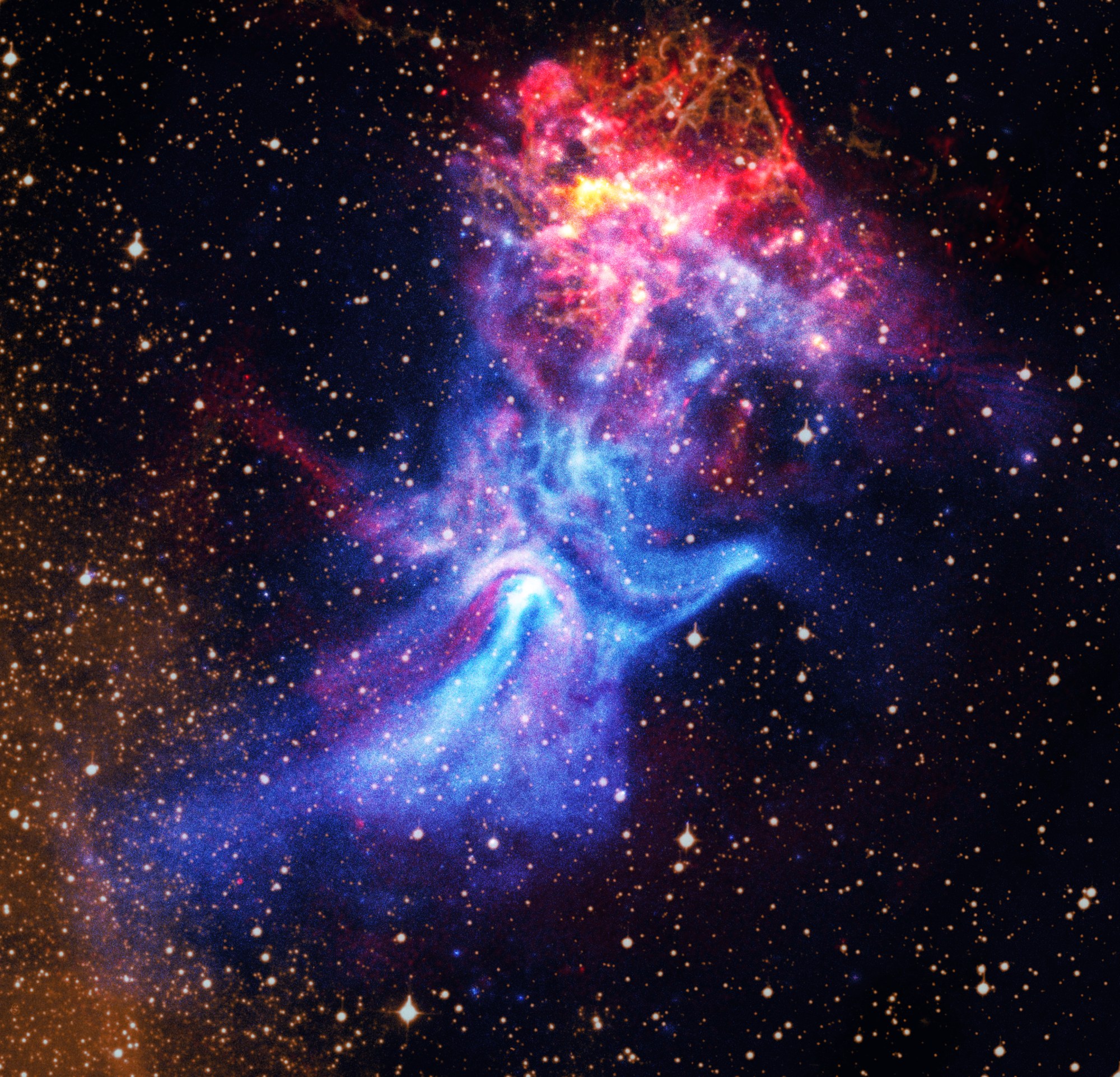
NASA has unveiled a stunning new composite image of a pulsar-driven nebula that has intrigued astronomers for its uncanny resemblance to a colossal cosmic hand.
The most recent depiction of the nebula, officially designated as MSH 15-52, merges X-ray data from NASA’s Chandra X-ray Observatory with newly gathered radio data from the Australia Telescope Compact Array (ATCA), providing new insights into this remarkable celestial formation.
At the center of the image lies pulsar B1509-58, a rapidly rotating neutron star that emerged from the collapse of a massive star during a supernova explosion. Despite measuring only about 12 miles in diameter, the pulsar releases intense streams of particles that illuminate a nebula extending over 150 light-years—approximately 900 trillion miles.
Initially captured by Chandra in 2009, the nebula’s radiant structure has fascinated both scientists and the general public due to its striking resemblance to an open hand, with a palm and outstretched fingers reaching toward the upper right of the image. In this latest rendition, the radio waves (depicted in red), X-rays (in blue, orange, and yellow), and optical data of hydrogen gas (in gold) converge to create a more intricate representation of the structure’s shape, behavior, and origins.
A Star’s Violent Past
The pulsar originated from the cataclysmic demise of a massive star. Once it exhausted its nuclear fuel, the core of the star collapsed, leading to a supernova that expelled the outer layers into space. What was left behind is B1509-58—a compact core rotating almost seven times every second and producing a magnetic field 15 trillion times more powerful than that of Earth.
This colossal energy propels a stream of high-velocity particles that engage with the surrounding gas and debris, creating the luminous nebula. The ‘hand’ we observe is essentially this particle wind illuminating the magnetic field and gas encircling the pulsar.

X-ray: NASA/CXC/Univ. of Hong Kong/S. Zhang et al.; Radio: ATNF/CSIRO/ATCA; H-alpha: UK STFC/Royal Observatory Edinburgh; Image Processing: NASA/CXC/SAO/N. Wolk
Layers of Data, Layers of Mystery
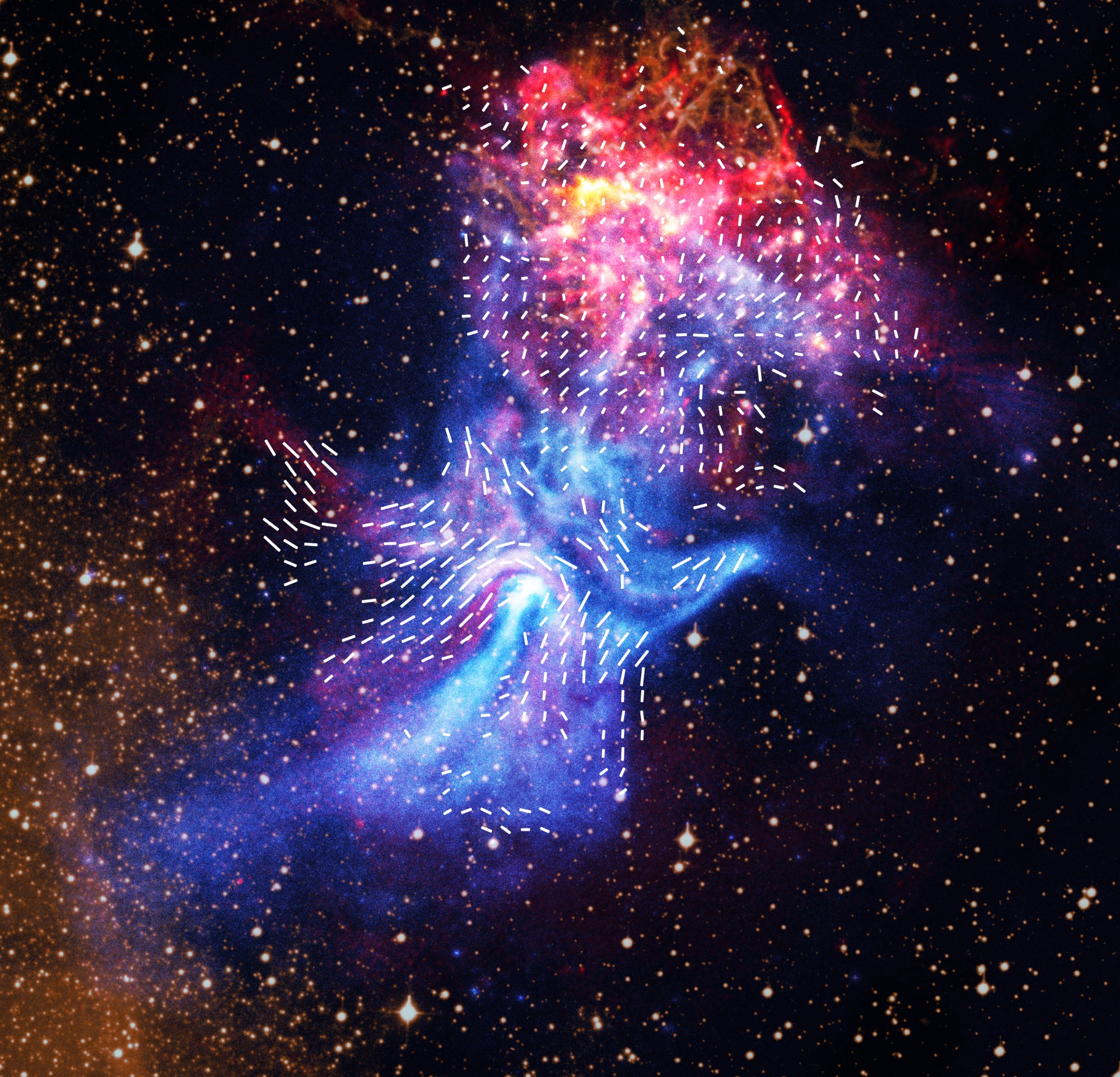
The incorporation of radio data from ATCA has unveiled filament-like formations—delicate strands aligned with the magnetic field of the nebula, likely created as the pulsar wind collides with supernova remnants. These filaments are depicted as short, straight white lines in additional images.
Curiously, some notable X-ray features—like a jet located beneath the pulsar and the inner sections of three of the ‘fingers’—are absent in radio wavelengths. Researchers theorize that this difference might result from highly energetic particles escaping a shock wave near the pulsar and moving along magnetic field lines.
The data also prompts new inquiries. In the upper right corner of the image, a distinct edge of X-ray emission indicates what scientists think is the supernova blast wave. However, unlike typical young supernova remnants, this boundary does not emit any detectable radio waves, leaving researchers baffled.
Additionally, the nearby supernova remnant RCW 89—the bright red and gold cloud at the top of the image—displays peculiar radio behavior, with irregular emissions that closely correspond to clumps observed in both X-ray and optical data. Scientists suspect it may be interacting with a nearby dense hydrogen cloud.
Even with the fresh insights, numerous enigmas persist regarding the formation and evolution of this complex structure. Researchers are optimistic that ongoing observation and modeling will illuminate the dynamic interaction between the pulsar wind and the remnants of the supernova.
X-ray: NASA/CXC/Univ. of Hong Kong/S. Zhang et al.; Radio: ATNF/CSIRO/ATCA; H-alpha: UK STFC/Royal Observatory Edinburgh; Image Processing: NASA/CXC/SAO/N. Wolk
Visual Description:
The composite image showcases a luminous blue nebula resembling a hand extending towards a cloud of red and gold. The “palm” and “fingers” of the hand radiate in X-ray blue, while the cloud above—composed of supernova remnants—glows in shades of red and gold. Golden star specks scatter across the background, and trails of radio and optical emissions impart a spectral, complex texture to the image. In areas where red and blue intersect, the fingers take on a purple hue, emphasizing the fusion of radio and X-ray data.