Astronomers utilizing NASA’s Hubble Space Telescope have captured images of the largest protoplanetary disk ever detected around a young star, revealing a chaotic and turbulent structure that is unlike anything previously observed in visible light. The results, published on Tuesday in The Astrophysical Journal, provide a rare insight into the potential formation of planets in extreme and dynamic settings.
This enormous disk encircles a young stellar system known as IRAS 23077+6707, situated approximately 1,000 light-years away from Earth. Commonly referred to as “Dracula’s Chivito,” the disk measures nearly 400 billion miles across—around 40 times the diameter of the solar system extending to the Kuiper Belt—making it the largest known planet-forming disk discovered so far.
Hubble’s observations showcase wisps and filaments of gas and dust that stretch far above and below the disk’s central plane, resulting in a turbulent look that contradicts long-standing beliefs about the relative tranquility of planet nurseries. Even more intriguing, the most striking filamentary structures are found only on one side of the disk, while the other side presents a sharp, relatively smooth edge.
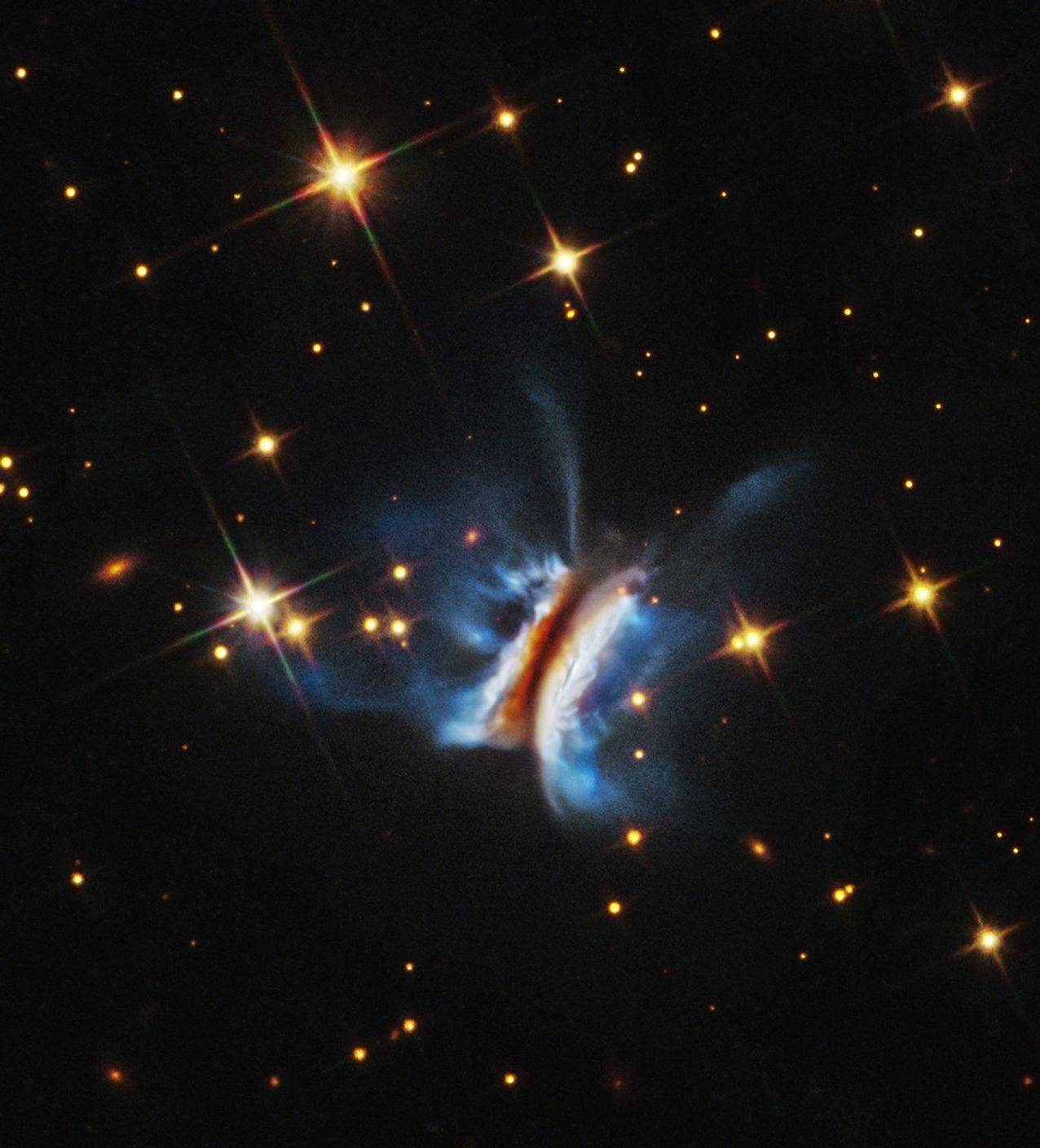
Image: NASA, ESA, STScI, Kristina Monsch (CfA); Image Processing: Joseph DePasquale (STScI)
“The level of detail we’re seeing is rare in protoplanetary disk imaging,” said lead author Kristina Monsch of the Center for Astrophysics | Harvard & Smithsonian. “These images show that planet-forming environments can be far more active and chaotic than we expected.”
The disk is viewed nearly edge-on from Earth, obscuring the central star or stars within it. Astronomers believe the hidden object may be a single hot, massive star or a closely bound pair. The disk’s edge-on orientation gives researchers an unusually clear look at its vertical structure, allowing them to trace features that are difficult to detect in other systems.
“We’re seeing this disk nearly edge-on and its wispy upper layers and asymmetric features are especially striking. Both Hubble and NASA’s James Webb Space Telescope have glimpsed similar structures in other disks, but IRAS 23077+6707 provides us with an exceptional perspective — allowing us to trace its substructures in visible light at an unprecedented level of detail. This makes the system a unique, new laboratory for studying planet formation and the environments where it happens.”
The asymmetry of the disk has particularly intrigued scientists. According to the research team, the one-sided filaments could be the result of recent infalling material, interactions with nearby gas, or other environmental effects that disrupt the disk’s balance.
“We were stunned to see how asymmetric this disk is,” said co-investigator Joshua Bennett Lovell, also of the CfA. “Hubble has given us a front-row seat to processes we don’t yet fully understand but now have the ability to study in unprecedented detail.”
Protoplanetary disks consist of gas and dust that slowly supply material to young stars, while also leading to the formation of planets. Estimates indicate that the disk surrounding IRAS 23077+6707 holds between 10 to 30 times the mass of Jupiter, offering ample raw material for the creation of several giant planets. Researchers suggest that this system could be a larger-scale representation of the early solar system.
Although planet formation in such a large and chaotic disk may vary from that in more tranquil settings, scientists believe that the essential processes are likely to be comparable. The recently obtained images confirm IRAS 23077+6707 as an important natural laboratory for examining how planetary systems develop across a diverse array of conditions.
Having operated for over thirty years, the Hubble Space Telescope continues to provide revolutionary insights into the cosmos. Jointly managed by NASA and the European Space Agency, Hubble remains a fundamental element of astronomical research and a crucial instrument for investigating the origins of stars and planets.