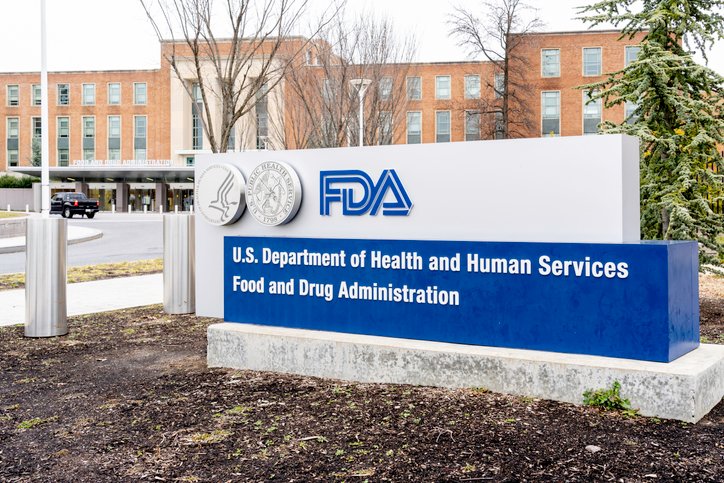
Washington, D.C., USA- January 13, 2020: FDA Sign at its headquarters in Washington DC. The Food and Drug Administration (FDA or USFDA) is a federal agency of the USA.
FDA Seeks Input on Mandatory In-Home Opioid Disposal to Curb Crisis
The U.S. Food and Drug Administration on Thursday issued a Request for Information seeking public comments on potential new standards for in-home opioid disposal products, aiming to reduce the risks posed by unused prescription painkillers lingering in American households.
The RFI is part of the agency’s ongoing efforts to combat the opioid epidemic, building on existing requirements that companies selling opioid analgesics provide prepaid mail-back envelopes to pharmacies and dispensers. FDA officials are now weighing whether to mandate that opioid manufacturers make in-home disposal systems available through those same outlets.
“Having unused opioids laying around at home can be a significant risk to those struggling with opioids and can be a gateway for opioid-naïve family members,” FDA Commissioner Marty Makary, M.D., M.P.H., said in a statement. “We need to develop creative ways to address opioid misuse and abuse.”
Currently, the FDA advises dropping off unused opioids at authorized take-back sites, using pharmacy-provided mail-back envelopes, or—for certain high-risk drugs—flushing them down the toilet, a method deemed to carry “negligible eco-toxicological risk” in a 2017 study published in the Science of the Total Environment.
The initiative aligns with the SUPPORT for Patients and Communities Reauthorization Act of 2025, which requires FDA guidance on safe in-home disposal, as well as President Trump’s Great American Recovery initiative. The RFI solicits feedback from industry, healthcare providers and advocates on suitable criteria for these disposal kits.
Responses to the RFI are due by 11:59 p.m. Eastern Time on April 6, 2026. All interested parties are invited to submit comments to the docket.
FDA Class 1 Recall: Medline Homecare Beds Pose Fire, Shock and Entrapment Risks
Medline Industries has issued an urgent Class 1 recall—the FDA’s most serious designation—for its Basic Homecare Beds after reports of hand control pendants sparking, overheating, melting and catching fire, which have been linked to 12 injuries and one death as of December 18.
The recall, which updates use instructions rather than requiring removal of the beds, affects specific models including SKUs MDR107002E, MDR107002E-4, MDR107003E, MDR107003E-4 and MDR107003ELO. Problems arise when beds are operated above weight limits, encounter obstructions or experience jammed components, causing pendant cords to overheat and potentially ignite, the FDA warned.

| Device Description | Item Number | UDI-DI |
|---|---|---|
| Medline Basic Bed, Semi Electric | MDR107002E | 40080196320999 |
| Medline Basic Bed, Semi Electric, Four Pack | MDR107002E-4 | 40080196320999 |
| Medline Basic Bed, Full Electric | MDR107003E | 40080196321002 |
| Medline Basic Bed, Full Electric, Four Pack | MDR107003E-4 | 40080196321002 |
| Medline Basic Bed, Low Full Electric | MDR107003ELO | 10080196546992 |
| Medlite Homecare Bed, Semi Electric | MDR107002L | 40080196294320 |
| Medlite Homecare Bed, Basic, Full Electric | MDR107003L | 40080196294344 |
| Medlite Homecare Bed, Low Full Electric, Basic | MDR107003LO | 40080196325901 |
Medline notified customers by letter on November 26, urging users to unplug beds from wall outlets except when making electrical adjustments, hang pendants on headboards or footboards when not in use, avoid storing them on mattresses and immediately unplug if motors jam, controls fail, wiring frays, pendants heat up or electrical hazards appear.
A separate hazard involves patient entrapment when using non-Medline side rails or accessories, which can trigger unintended bed movement and trap users between the frame and attachments—resulting in two additional injuries and one death. Only compatible Medline rails like MDS89697, MDS89698N, MDS89694N and MDS89695N should be used; extension cords and other non-approved items are prohibited.
The AC-powered adjustable beds, designed for home medical use with electric motors and patient-operated remotes, were flagged after customer incident reports. Medline has ceased production involving the problematic mixer and asks affected customers to contact 866-359-1704 or recalls@medline.com with questions or adverse events. Health professionals and consumers can report issues to the FDA’s MedWatch program.
FDA Cracks Down on 30 Telehealth Firms for Misleading GLP-1 Drug Claims
The U.S. Food and Drug Administration on Thursday sent warning letters to 30 telehealth companies accused of making false or misleading claims about compounded GLP-1 products marketed on their websites, intensifying the agency’s campaign against deceptive pharmaceutical advertising.
“It’s a new era. We are paying close attention to misleading claims being made by telehealth and pharma companies across all media platforms—and taking swift action,” FDA Commissioner Marty Makary, M.D., M.P.H., said in a statement. “Compounded drugs can be important for overcoming shortages or meeting unique patient needs—but compounders should not try to compound drugs in a way that circumvents FDA’s approval process.”
The letters represent the second wave of warnings to telehealth outfits since the FDA launched its crackdown on direct-to-consumer drug ads last September. Over the past six months, the agency has issued thousands of such notices—more than in the entire previous decade—targeting violations like implying compounded drugs are identical to FDA-approved versions or obscuring their origins by branding them with the company’s own name or logo.
Compounded drugs, unlike FDA-approved generics, undergo no agency review for safety, effectiveness or quality before hitting the market. The telehealth firms’ promotions allegedly blurred these lines, misleading consumers about the products’ status and sourcing.
FDA Forms Expert Panel to Tackle Rising Food Allergy Crisis
The U.S. Food and Drug Administration has assembled a high-profile expert panel to address food allergies, inviting public comments through the Federal Register docket FDA-2026-N-1925 as part of its push to confront a growing public health challenge.
The roster features leading specialists including Ruchi Gupta, MD, MPH, director of Northwestern University’s Center for Food Allergy & Asthma Research; Gideon Lack, professor of pediatric allergy at King’s College London; and Hugh A. Sampson, MD, emeritus director of the Jaffe Food Allergy Institute at Mount Sinai.
Other members include clinical psychologist Linda Jones Herbert of Children’s National Hospital, Stanford’s Michelle Huffaker, MD, UNC’s Edwin Kim, MD, MS, and FDA insiders like Stefano Luccioli, MD, and Alkis Togias, MD, from the National Institutes of Health.
The panel also counts Food Allergy Research & Education CEO Sung Poblete, PhD, RN; NIAID’s Ronald L. Rabin, MD; and FDA’s Richard Iorio, MD, and Kelly Stone, MD, PhD, blending academic, clinical and regulatory expertise to explore prevention, treatment and policy gaps.