Astrobotic, Firefly Aerospace, and Intuitive Machines selected for four lunar deliveries scheduled for late 2028
NASA announced Tuesday the selection of three companies to deliver science payloads to the lunar surface in late 2028, awarding contracts totaling approximately $600 million as part of the agency’s Moon Base Program. Astrobotic received $297.9 million for two deliveries, while Firefly Aerospace secured $144.2 million and Intuitive Machines received $148.3 million for one delivery each.
The awards are made through the agency’s Commercial Lunar Payload Services initiative, which serves as a backbone for lunar infrastructure development. Each company will use updated versions of previously flown lander designs to support NASA’s increased mission cadence.
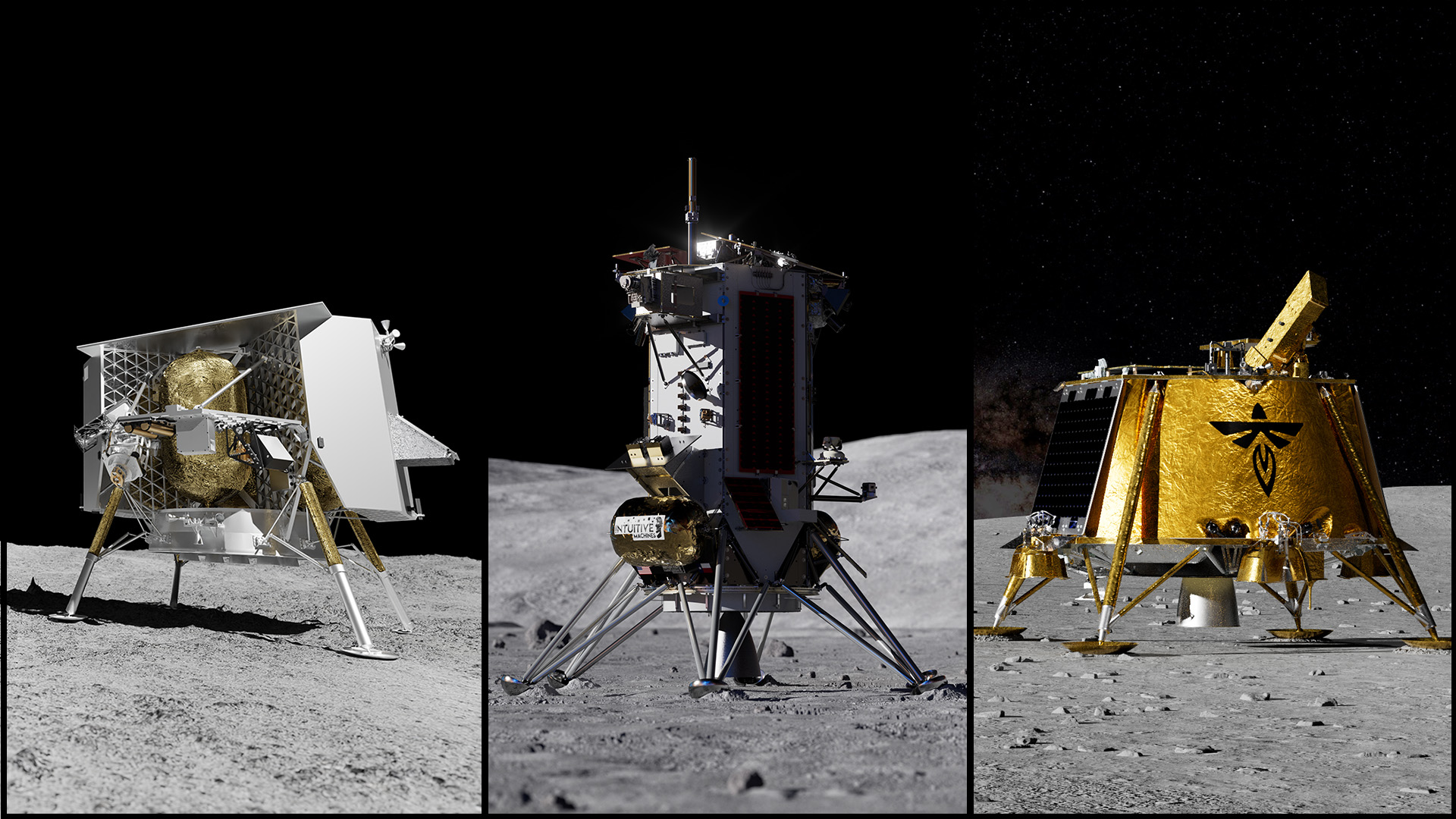
Credit: Astrobotic/Intuitive Machines/Firefly
“These new awards to our commercial partners, totaling nearly $600 million to land more missions on the Moon with science payloads, demonstrate our commitment to accelerating our effort to build a long-term presence on the lunar surface,” said Lori Glaze, associate administrator for the Human Spaceflight Mission Directorate at NASA Headquarters in Washington. “They give us more opportunity to develop the skills we need to prosper there.”
Each delivery will carry three NASA payloads to the lunar surface, selected for their ability to support safe human exploration. The Stereo Camera for Lunar Plume Surface Studies will use four cameras to produce 3D views of engine exhaust plume impacts on lunar dust during landing, aiding in the development of models to predict dust erosion and ejecta characteristics. The Laser Retroreflector Array, a small passive device containing eight quartz corner-cube prisms, will reflect laser beams from orbiters or landing spacecraft to help determine position and navigation. The Linear Energy Transfer Spectrometer will measure the radiation environment at different lunar locations using advanced silicon detector technology.
“We’re building a proving ground for Moon Base operations,” said Ryan Stephan, NASA’s Moon Base acting director of cargo landers. “Accelerating our Moon mission ordering cadence and launch opportunities enable us to move quickly to learn, iterate, and improve.”
NASA also previewed additional contracting opportunities for American industry. The agency is considering plans to send PROMISE, a hybrid engineering development version of the Mars Perseverance and Curiosity rovers, to characterize the lunar surface and subsurface and prospect for resources. In the coming months, NASA plans to solicit proposals for lunar landers to deliver a power and avionics technology demonstration, additional science payloads, and a South Pole optical imager. The agency will also issue an open solicitation for Moon Base technology demonstrations and seek a lunar communication and navigation relay constellation.
“By flying the same science instruments on multiple landers, we will better understand potential hazards during landing and build out a global network of environmental data and location markers on the Moon,” said Joel Kearns, deputy associate administrator for exploration, Science Mission Directorate at NASA Headquarters. “It’s akin to having weather stations in different locations on Earth. These three payloads are flight-proven and their data is critical to supporting safe human exploration of the lunar surface.”
The awards announced June 30 bring the total number of lunar surface deliveries across multiple providers to 17. The companies are responsible for initiating procurements, assessing similar previous lunar landers, and incorporating lessons learned to improve mission reliability. NASA noted that the agency is reviewing options for these landers to deliver potential additional payloads beyond the three already assigned.
About the Author