“I Feel Nothing. What Next?” Charli xcx Gets Everything She Wanted — And It’s Terrifying.
In a biting meta-satire born from the fallout of ‘brat,’ the pop provocateur plays a fictionalized version of herself grappling with the one thing she never expected: the emptiness of getting everything she wanted.
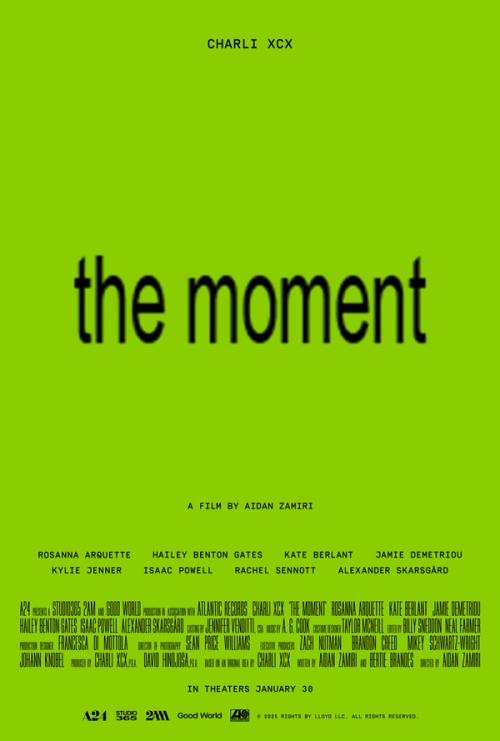
For most of her career, Charli xcx has been pop music’s favorite outsider — a cult darling with a decade-plus résumé of underground credibility, critical acclaim, and just enough commercial success to keep the machine humming but never quite roaring. Then came brat. The summer of 2024 happened. Lime green became a global mood. And suddenly, the Essex-born artist found herself on top of a very different world.
What does that feel like? Not what you’d think.
The Moment, the audacious feature debut from director Aidan Zamiri (a longtime music video collaborator and photographer), answers that question with a knowing smirk and a jagged edge. Described as a “mockumentary period piece of 2024,” the film follows a fictionalized Charli xcx in the dizzying, suffocating weeks after brat explodes into an international sensation. She’s prepping for her first arena tour. Everyone wants a piece of her. And she’s quietly coming undone.
“It’s a music industry satire, and it’s a comedy, but it’s also really tragic,” Charli says of the film, which she conceived from a deeply personal document she shared with Zamiri toward the end of that transformative summer. “It’s talking about these real feelings at this point in time when I am supposed to be feeling on top of the world… And then you are standing there thinking, ‘O.K., but I feel nothing. What next?’”
The film’s origin story is almost as meta as the film itself. In late summer 2024, as brat reached critical mass and the term “Brat Summer” became inescapable, Charli sent Zamiri a raw, melancholic piece of writing. It wasn’t a press release or a pitch. It was a diary entry about alienation.
“She had worked for half her life towards this thing — she always felt it was unattainable, always felt like an outsider, and then suddenly got it,” Zamiri recalls. “All she could really feel now that she was holding her dream in her hands was it slipping through her fingers. All she could see was the impending irrelevance or an end in sight.”
That document became the skeleton key for The Moment. Working with co-writer Bertie Brandes, Zamiri built a script around that core anxiety, layering in a sharp satirical take on the entertainment industry’s voracious, sanitizing appetite. The result is a film that exists somewhere between vérité documentary and fun-house mirror — “a revisionist history of brat,” as Charli puts it.
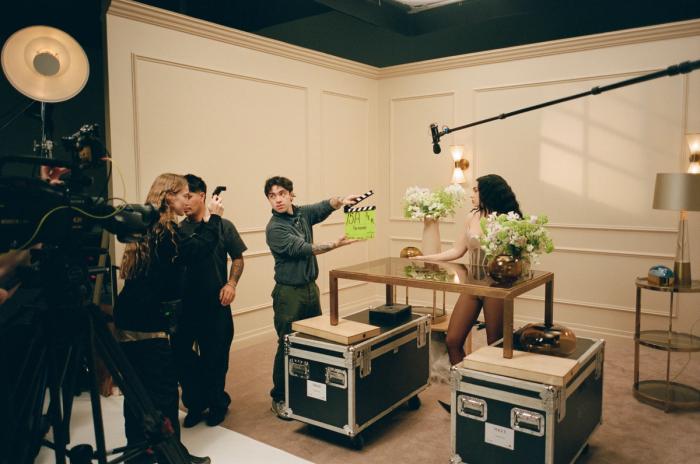
The Machinery of Stardom
In The Moment, the newly minted superstar is caught in a revolving door of obligations: performances, photo shoots, brand deals, and — the film’s narrative engine — pressure to make a concert documentary. Enter Johannes (Alexander Skarsgård), a slick, parasitic director hired by the label to deliver a four-quadrant, family-friendly version of brat. His vision clashes violently with that of Charli’s creative director, Celeste (Hailey Benton Gates), the only one in her orbit fighting to preserve the original, scuffed-up ethos of the project.
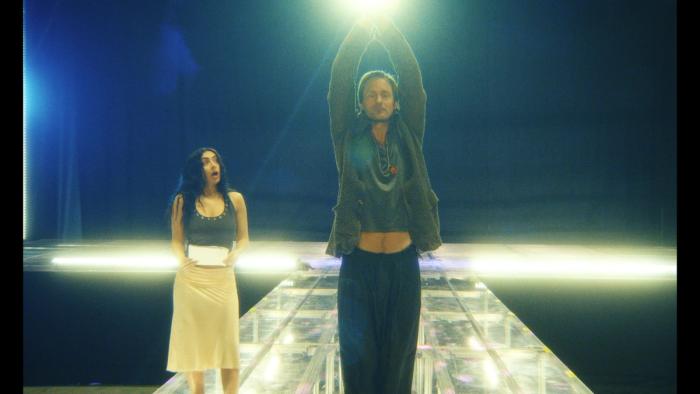
Above them all looms Tammy (Rosanna Arquette), a steely label head who doesn’t do malice — just business. “She understood that Tammy isn’t malicious — Tammy’s a businesswoman,” Zamiri says. “She was so great. She would do a scene and apologize to people saying, ‘I’m not like this,’ because she was able to perform such a nightmare-ish character on-screen.”
The supporting cast rounds out with Jamie Demetriou as Tim, Charli’s hapless but oddly tender manager (“the heart and soul of the film,” Charli calls him), plus a parade of cameos — Rachel Sennott, Julia Fox, and, in her first acting role, Kylie Jenner, whom Zamiri calls “the turning point of the film.”
For Charli, stepping into the lead role meant untangling three versions of herself: the real person, the public performer, and the fictional character in a deliberately distorted fun-house reflection. She prepared for the role in “quite a classic way,” treating the on-screen Charli as a separate character with her own arc.
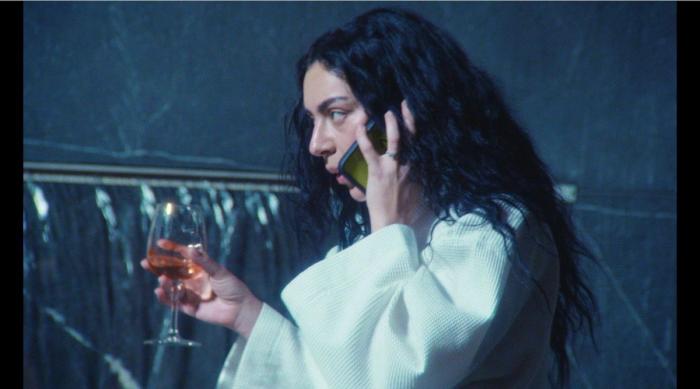
“I really want to tell stories that don’t always show the protagonist in this really clear, easy, hero-positive light,” she says. “I’m interested in telling stories that make you feel a little bit uncomfortable and wonder about that person’s morality and integrity and vulnerability.”
That discomfort hits hardest in scenes where the fictional Charli caves to commercial pressure — notably a sequence where she’s hoisted on wires, doused in glittery green, and turned into a limp corporate mascot. “I cried before that scene,” she admits with a laugh. “My real creative director was there… She said, ‘You look so uncool.’”
Cinematographer Sean Price Williams (Good Time, The Sweet East) shot the film with a documentarian’s restlessness — reactive, slightly delayed, as if the camera itself is struggling to keep up with Charli’s unraveling. Production designer Francesca Di Mottola built out the contrast between windowless, bunker-like rehearsal spaces and glass-walled exposure, a physical manifestation of claustrophobia and public scrutiny.
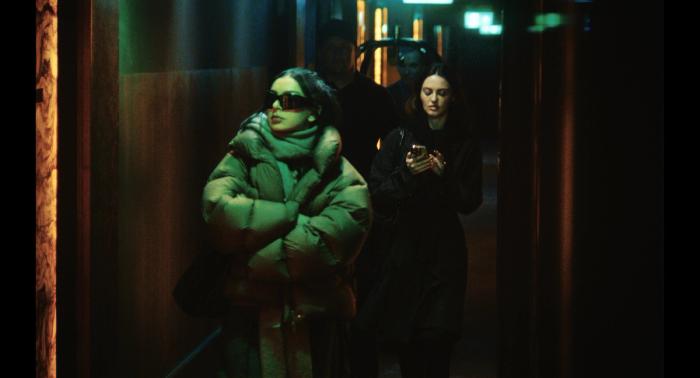
Composer A. G. Cook, Charli’s longtime collaborator and brat executive producer, created an original score that avoids the album’s vocals entirely, instead using digital textures that morph between hard synth and delicate fragility. “The paradox — hard vs. soft, confident vs. fragile — is really at the heart of the film,” Cook says.
The End as Freedom
The Moment is not a cradle-to-grave biopic or a conventional concert film. It’s a chamber piece about a single, paralyzing question: What happens when the summer ends? For the Charli of the film, the answer involves a kind of creative death — a willingness to let the original idea be destroyed or co-opted in order to move forward.
That lesson, the real Charli says, took years to learn. “You have to figure out a way to be O.K. with rejecting the control of the response. You have to kind of grieve it, or in the case of the film, actually sort of destroy the original idea. That’s freedom.”
About the Author